
Five-a-side house rules: what does your game play?
Nobody in the area, no passing back, head height, slide tackles and the boards: the rules every five-a-side has to agree, and the ones that just make sense.
Updated November 2026
Every five-a-side has rules. Most of them were never written down. They live in the heads of the three people who've played the longest, and they come out mid-game, usually as "you can't do that". The new lad didn't know, the keeper swears it's always been allowed, and two minutes later you're still arguing about it.
Here are the rules every game has to settle one way or the other, the options people use, and the unwritten ones that keep everybody coming back. Pick yours, write them down and share them before kick-off.
Build your own house rules Pick what your game plays, then copy the rules into the group chat, or send a link round to argue about first.
Our house rules
This is what we play at The Tuesdays FC, the weekly game 5asider was built for. The usual rules of football apply, plus these:
- Nothing reckless: everyone's got work tomorrow.
- No slide tackles.
- Only keepers in the area, and the keeper stays in it.
- Nothing over head height: no playing it over someone's head to beat them, and nothing obviously high.
- Keepers can throw or kick it out, but under head height, or the other keeper restarts.
- Shoot from anywhere.
- Passing back to the keeper is fine.
- After a goal, the keeper restarts.
- Kick-ins when it goes out at the side.
- Keepers can score in open play, but not straight from a restart of play.
- Fouls and handballs are direct free kicks. Everything else is indirect.
If you play at a centre, its rules come first. The rest of this page explains each rule and the other versions groups play.
The area
Most five-a-side pitches have a semicircle in front of each goal, the D. What happens inside it is the most argued-about rule in the game. There are three common versions:
- Nobody in the area but the keeper. The usual rule at five-a-side centres. Outfield players can't go in, attacking or defending, so every goal is a shot from outside. It's what we play.
- The keeper can't come out. Usually alongside the first rule: the area is the keeper's, and only theirs. It stops the keeper becoming a sixth outfield player.
- No area at all. Play it like a small pitch, with anyone anywhere. Fine on pitches without markings, but goalmouth scrambles get crowded and shins get hurt.
If you play the no-go area, agree what happens when someone strays in by accident. Most games keep it simple: a defender in the area is a penalty or a free kick from the edge, and an attacker in it means no goal.
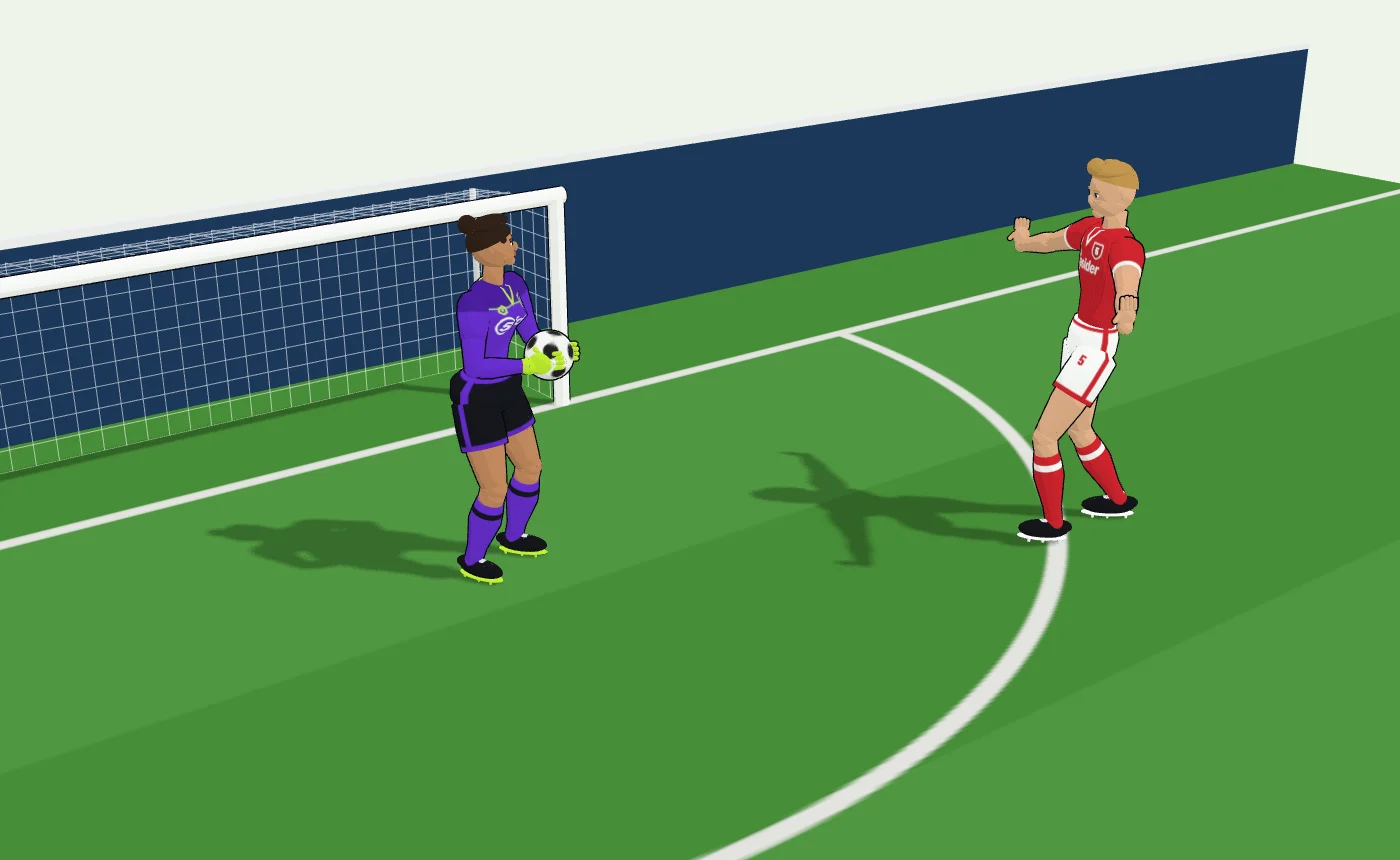
Where the area starts, and what counts as in
The no-go area raises its own arguments. These answers keep them short:
- It's your feet that count. When you kick the ball, neither foot can be in the area, standing foot included. It's simpler to call than where the ball was.
- The line is a 50/50 zone. A ball on the line is anyone's: the keeper can pick it up, and outfield players can kick it.
- Following your shot in is fine, as long as you gain nothing by it. If your run carries you into the area after you've struck the ball, play on. If you then get the rebound, or get in the keeper's way, it's no goal.
- No shortcuts. Running across the area to get to the other side quicker is gaining an advantage. Go round.
- A loose ball in the area is the keeper's. Nobody goes in after it, not even to clear it: that's how keepers get hurt. Nobody wants to injure the keeper on a Tuesday night.
Passing back to the keeper
Under pressure, every defender's first thought is to roll it back to the keeper. Games settle it one of three ways:
- Allowed. Simple, good for groups where nobody fancies being caught on the ball, and what we play.
- Allowed, but no hands. Like the full-size game: the keeper has to play it with their feet.
- Not allowed in your own half, or not at all. It keeps the game moving and stops a team that's winning from sitting on it.
We don't have a pass-back rule at The Tuesdays FC: pass it back and the keeper can pick it up.
Most centres that ban it give an indirect free kick to the other side. In a friendly game, just give the ball to the other team where it happened.
Back to your rulesShooting from anywhere, or only in their half
Some games let you shoot from anywhere. Others only count a goal scored from the other team's half, which stops anyone lumping it at goal from their own end and makes teams pass their way forward.
- From anywhere. The simplest, and what we play. On a small pitch, a shot from your own half is rarely a good idea, and the keeper usually deserves the embarrassment if it goes in.
- Only from the other half. Good for big pitches and long-ball merchants. Agree what happens to a goal from too far out: usually a goal kick to the other side.
Can the keeper score?
Then there's the keeper. At The Tuesdays FC we once had a keeper's goal, and it caused an argument that ran well past full time. Here's where we landed:
- In open play, yes. If a team-mate passes it back and the keeper hits it the length of the pitch and in, it counts.
- From a restart of play, no. A restart is any time play starts again: after a goal, a goal kick, the keeper's ball when an attacker strays into the area, a free kick, or a stray ball from the next pitch. None of those is a shot. Someone else has to touch it first.
Head height
The head-height rule says the ball can't go above head height. It's common indoors and at many centres, and it changes the game completely: no lumping it forward, no hoofing it clear, and far fewer balls in the face at close range.
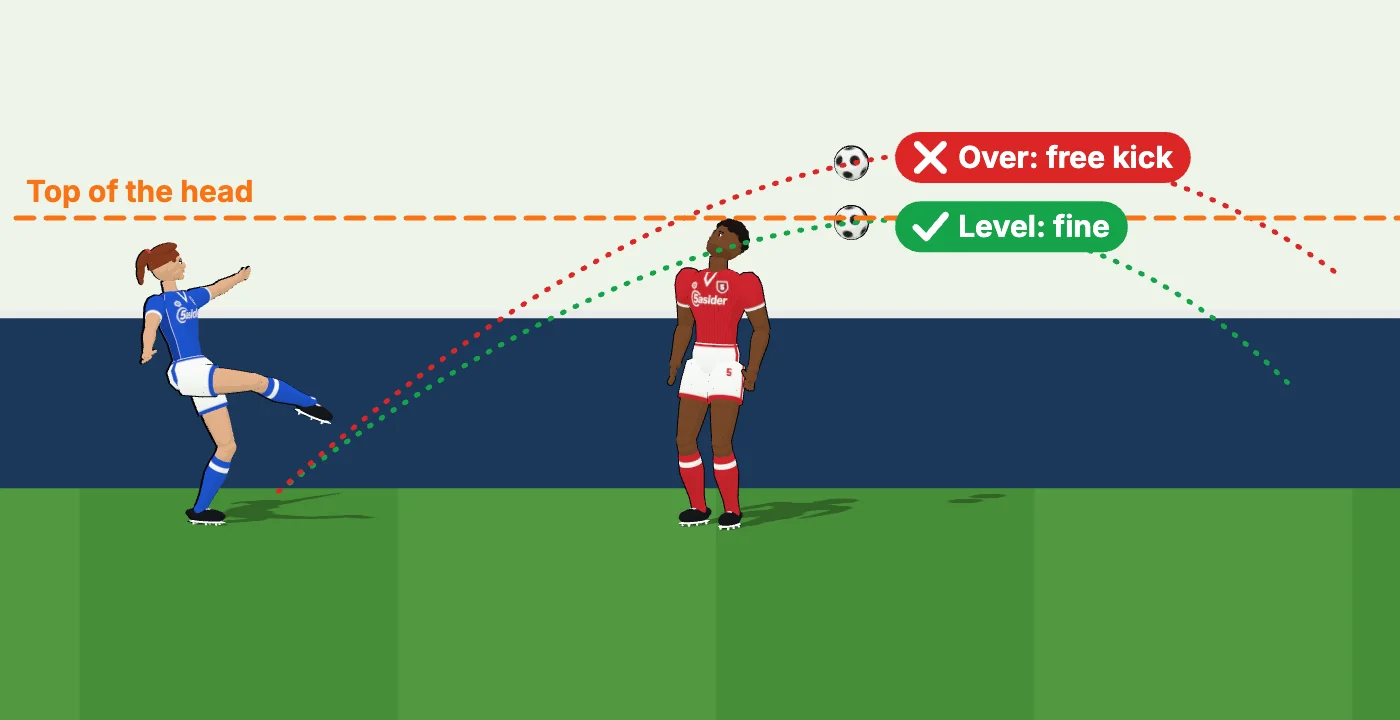
Over head height means the whole ball goes over: its bottom is above the top of a player's head. A ball level with someone's head is fine.
Whose head? That's the argument. Three answers, easiest first:
- Did it gain an advantage? The easiest version to play, and ours. If it went over someone nearby to beat them, it's a free kick. So is anything obviously high. A close call where nobody gained anything is play on.
- The tallest player on the pitch. Clear, as long as everyone knows who that is.
- A fixed height, roughly the crossbar on a full-size goal. Fair, but hard to judge from twenty yards away.
Whichever you pick, the call goes to the player nearest the ball, and the restart is an indirect free kick (no scoring direct) where it was hit. Some exceptions most games agree on:
- Saves. If the keeper saves it and it flies up, play on.
- Off the frame. A shot that comes off the post or the bar and goes high isn't head height either.
- Off the boards, it's whoever touched it last. If your pass deflects off an opponent, stays low, and then goes high off the side boards, it's head height against the opponent: they touched it last.
And which parts of the pitch it covers:
- Head height everywhere. The strict version.
- Head height in the area only. Chips and lofted passes are fine outfield, but no shots or crosses into the area above head height.
- No limit. Overheads, chips and scissor kicks all allowed. More fun, more balls in the face.
Then there's the keeper's own throw or kick out. Three common versions:
- Throw or kick, but under head height. If the keeper sends it out over head height, the other keeper restarts. Simple, and it stops the keeper launching it to a striker.
- Any height. The keeper is the one player head height doesn't apply to.
- Roll it out. The strictest: no throwing or kicking at all.
Slide tackles
Almost every five-a-side bans slide tackles, and almost every centre does too. On astro or 3G, sliding takes the skin off your legs. Indoors, it's just dangerous. And in a tight space with the boards close by, someone always ends up in a heap.
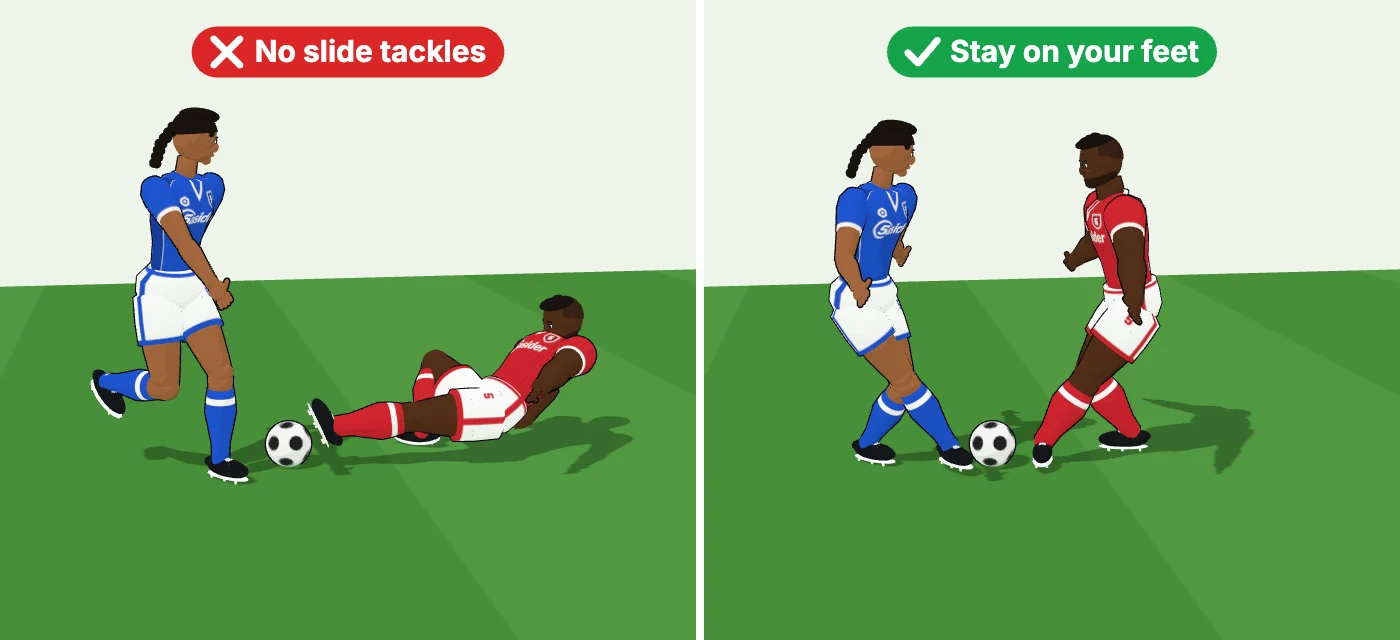
Make it simple: no slide tackles, no going to ground to block, and a free kick if anyone does. Keepers can go down in their area to make a save, nobody else.
Back to your rulesThe boards, and when it goes out
Some pitches have boards or fences all the way round, and the ball never goes out. Others have open sides. Agree which of these you play:
- Play off the boards. The side of the pitch is a team-mate: a wall pass off the boards is a proper skill.
- Kick-ins. On open pitches, a ball over the side line comes back with a kick-in, not a throw. Usually the kicker can't score direct, and opponents stand back a couple of metres. Some games still take throw-ins.
- Over the top. Over the fence or the netting, and the other side gets a free kick (or a kick-in) where it went over. Whoever kicked it goes to fetch it.
We have boards at The Tuesdays FC, so the ball nearly always stays in. The odd time it gets stuck up in the netting, the other team takes a kick-in from where it went up.
Careful near the boards
The boards hurt. Never shove, barge or run someone into them, and ease off when a player's pinned against them with the ball. It's a free kick at most centres and a sore shoulder everywhere.
Fouls and free kicks, when there's no referee
Most weekly games don't have a referee, so somebody has to decide. The rule that works: the player who was fouled calls it, and the other side accepts it. If nobody's sure, play on.
Free kicks are taken where it happened. Two kinds keep it simple:
- Direct, for fouls and handball. You can shoot straight from it.
- Indirect, for the rule-breaks that aren't fouls: head height, passing back, and anything else your house rules ban. Someone else has to touch it before it can go in.
Opponents stand two metres back, or two big strides: nobody carries a tape measure. Penalties are rare: keep them for a foul that stopped a sure goal, or a defender handling in the area.
A few other things are worth agreeing:
- A ball from the next pitch: stop the game, and give the ball back to the team that had it when the stray one came on, where they had it (to the keeper, if it was theirs). Nobody challenges for it: like a drop ball, without the drop.
- After a goal: some games take a kick-off from the centre spot. At The Tuesdays FC the keeper just plays it out, which keeps the game moving and saves everyone the walk back, and the keeper can't score straight from it.
- How long: play the full hour, or stop when the next booking walks on.
- Next goal wins: on or off. If it's on, agree when, or it'll be called at 9–2.
- Rolling subs for anyone extra: on and off at the halfway line, every five minutes or after every goal. (More in odd numbers at five-a-side.)
The unwritten rule: everyone's got work tomorrow
This is the one that matters most. It's a kickabout. Everyone on that pitch has a job, a school run or lessons in the morning, and none of them can do it on crutches.
- No reckless challenges. No two-footed tackles, no going through the back, no studs showing. If you're late, pull out of it.
- Play to the level of the game. If you used to play properly, great. Pass more, and don't take on the dad who hasn't played since school at full pelt.
- Mind the gaps in fitness. Someone coming back from injury, someone new, someone twice your age: let them play.
- Say sorry. Clipped somebody? Help them up. It costs nothing, and it stops the next tackle being a "reply".
- Leave it on the pitch. Whatever was said in the game stays there. Shake hands at the end.
Groups that get this right play together for years. Groups that don't lose a player a month, and then the game. (More on that in how to keep your weekly five-a-side going.)
Back to your rulesQuestions people ask
Can you go in the D in five-a-side?
At most five-a-side centres, no: only the keeper can go in the area. In your own game, it's whatever you agree, but "keeper only" is the most common rule.
Is there a head height rule in five-a-side?
Often, especially indoors and at centres, where the ball can't go above head height. Many casual games drop it outdoors. Agree it before you start.
Whose head is head height?
The simplest answer: if it clearly went over someone nearby to beat them, or it was obviously high, it's head height. A close call where nobody gained anything is play on. Some games use the tallest player, or crossbar height. Saves and shots off the frame don't count.
Is a five-a-side free kick direct or indirect?
Usually direct for fouls and handball, and indirect for head height and passing back. Opponents stand two metres, or two strides, back.
Is there offside in five-a-side?
No. Offside is in the full game's Laws of the Game, but five-a-side is played without it, at centres and in casual games.
Can the keeper pick the ball up on the line of the area?
In most games the line is a 50/50 zone: the keeper can pick it up there, and outfield players can kick it.
Are slide tackles allowed in five-a-side?
Almost never. Most centres ban them, and on artificial grass they're painful for everyone. Keepers can usually go down in their area to make a save.
Can the keeper come out of the area?
Under the usual centre rules, no. In casual games, some let the keeper come out and play as a rush goalie. See playing in goal at five-a-side.
Back to your rulesWhat happens when a ball comes on from another pitch?
Stop the game. The team that had the ball gets it back where they had it, unchallenged.
Can you score from your own half in five-a-side?
In most casual games, yes: you can shoot from anywhere. Some games only count goals from the other team's half, so check before you try it.
Can the keeper score in five-a-side?
Usually yes in open play, if the keeper shoots from a pass. Not straight from a restart of play, such as after a goal, a goal kick or a free kick: someone else has to touch it first.
Is there a kick-off after a goal in five-a-side?
Some games take one from the centre spot. Many just let the keeper restart, which is quicker.
Back to your rulesWho decides fouls without a referee?
The player who was fouled. Everyone else accepts the call and gets on with it.
Sources
The rest comes from Martin's own games at The Tuesdays FC: the rules we play by, the versions other games use, the player who was fouled calling it, and everyone having work in the morning.
Advertisement
Agree the rules, then play.
Create a squad, add your players and your first game in a few minutes. Free, nothing to install, and players reply from the email.