
What Sensible Soccer taught us about five-a-side
Top-down, tiny players, aftertouch and one-twos: if you grew up on Sensible Soccer and still play five-a-side, a lot of it carries over.
Updated November 2026
If you were a teenager in the early nineties, there's a fair chance you spent more hours on Sensible Soccer than on homework. A little green pitch, players the size of a fingernail, a joystick and a fire button that took a beating. Thirty-odd years on, plenty of us still play every week, just with worse knees and real bibs.
A lot of what that game taught us holds true on a five-a-side pitch on a Tuesday night. This one's for anyone who still remembers their favourite way to score.
In short
- Sensible Soccer showed you the whole pitch. On the astro, look up and see it too, before the ball arrives.
- The one-two was the best move in the game, and it's still the best move in five-a-side.
- Curl it low into the far corner. Placement beats power, on screen and off.
- Keep it simple, and keep the teams fair. That's what makes people come back.
A quick reminder, for those of us who need one
Sensible Soccer came out in 1992, made by Sensible Software, the studio Jon Hare and Chris Yates started in Essex. It ran on the Amiga, the Atari ST and the PC.
In 1994 came Sensible World of Soccer, with a career mode and around 1,500 clubs, many of them gloriously obscure. If you ever took a side from a league you couldn't find on a map to the top, you know.
What set it apart was the view. Other football games got in close. Sensible pulled the camera right back: a bird's-eye view of a big chunk of the pitch, tiny players zipping about. Simple controls, fast, and you could pick it up in a minute and still be learning it a year later.
That's a fair description of five-a-side, too.
See the whole pitch
The zoomed-out view meant you could see where everyone was before you got the ball. The good players knew where the pass was going before it arrived.
Real football calls that scanning. Before the ball comes to you, take a quick look over each shoulder:
- Where's the space?
- Who's free?
- Who's about to close you down?
In five-a-side you get about a second on the ball. Those two glances are the difference between a neat pass and getting pinned against the boards.
We can't zoom the camera out on a Tuesday night. But we can lift our heads up, which is more or less the same thing.
The Sensi way up the pitch
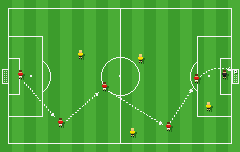
Everyone had a move. One of the classics went like this: the keeper rolls it out to the full-back, the full-back plays it into midfield, midfield knocks it out to the wing, the winger finds the striker, and the striker curls it inside the far post. Five passes, one goal, and it worked far more often than it should have.
It works on a Tuesday night too, with five players instead of eleven. The keeper rolls it out to whoever's dropped wide, it goes into the middle, out to the side, and into the striker. On a small pitch every pass drags a defender with it, and by the fourth there's usually a gap at the far post. The picture at the top shows it on both pitches.
The one-two is still the best move in football
Ask anyone who played it and their favourite route to goal usually involved a one-two. Pass, run, get it back, you're through. Five-a-side rewards exactly the same thing: on a small pitch, a defender who follows the ball is always a step behind the runner.
The trick is the same as it was on the joystick: the moment you've passed, move. Not a jog, a proper run into the space behind the defender. Whoever you passed to gives it back first time, into your path, not to your feet.
Two touches and you're past someone who did nothing wrong.
Five-a-side tactics has more on moving after you pass. It's the one habit that makes an ordinary team hard to play against.
Aftertouch, and why you should curl it
Sensible Soccer had aftertouch: after you'd kicked the ball, you could bend it with the joystick. Wildly unrealistic and completely brilliant. Everyone had their own way of swerving one round the keeper, and everyone was sure theirs was the best.
Your left foot doesn't do aftertouch, sadly. But the lesson stands. A lot of goals at five-a-side aren't blasted. They're placed, low, just inside the post. Leathering it usually finds the keeper, the boards or the next pitch along.
The curler, without a joystick
- Open your body and use the inside of your foot.
- Start the ball outside the far post and let it come back in.
- Keep it low: the goals are small, most keepers reach a high one, and a low shot skids on astro.
Ten minutes trying this before kick-off does more than a month of trying to break the net. There are more ideas in skills and drills for small spaces.
Keepers and the near post
Everyone who played Sensible had a spot they scored from again and again. In real football the near post is where keepers get caught, and at five-a-side it's the goal nobody forgives.
- In goal: shuffle towards the side the ball's on and make the near post yours.
- Shooting: test the keeper early at the near post. Once they're covering it, the curler to the far side is on.
Playing in goal at five-a-side goes through where to stand.
The joy of a simple game
Part of why Sensible Soccer is still loved is that it didn't try to do everything. A joystick, a button, a ball. You learned it in minutes and spent years getting better.
A weekly five-a-side is the same. No fixtures, no committee, no coach. Ten people, a booked pitch, two sets of bibs. It's at its best like that: turn up, play, have a laugh, go home. Any organiser who's tried to add more structure than the game needs will tell you so. And it doesn't even need a good pitch: people have played on rafts, rooftops and the Antarctic ice.
Picking the teams
Choosing your side was half the fun. Everyone wanted the strong teams, and whoever lost the argument got the leftovers.
At five-a-side, that same argument is what kills a weekly game. If one lot win every week, the others stop coming. Fair teams matter more than any tactic in this piece. There's a whole guide on how to pick fair five-a-side teams, and 5asider can split whoever's playing for you, from your squad's own results, so nobody's stuck with the leftovers every week.
Still playing it
If this has you itching for a go, the game never really went away. An open-source project called OpenSWOS has rebuilt Sensible World of Soccer to run on today's computers and phones. You need your own copy of the original, and the 96/97 PC version is still on sale.
Play a few, get your aftertouch back, then go and try the curler for real on Tuesday.
5asider isn't connected with Sensible Software, anyone who makes or sells Sensible Soccer or Sensible World of Soccer, or the OpenSWOS project. We just loved the game.
Questions people ask
When did Sensible Soccer come out?
In 1992, on the Amiga, the Atari ST and the PC. Sensible World of Soccer followed in 1994.
Who made Sensible Soccer?
Sensible Software, the studio started by Jon Hare and Chris Yates.
Can you still play Sensible World of Soccer?
Yes. The 96/97 PC version is still sold, and OpenSWOS, an open-source rebuild, runs it on modern computers and phones if you have your own copy.
Does the one-two really work at five-a-side?
Yes. On a small pitch, a defender who watches the ball loses the runner. Pass, move straight away, and ask for it back into space.
Sources
- Sensible Soccer, Wikipedia
- Sensible Software, Wikipedia
- Sensible World of Soccer, Wikipedia
- How to install OpenSWOS, OpenSWOS
The rest comes from Martin's memories of playing it and his own games at The Tuesdays FC: the moves everyone had, and how they work at five-a-side.
Advertisement
Pick up the stick, then the boots.
Create a squad, add your players and your first game in a few minutes. Free, nothing to install, and players reply from the email.